— Dr. Dongming Liu, Chief Urologist at Shanghai United Family Healthcare
Going into the ER for one problem and accidentally discovering another is the kind of thing people politely call fortunate timing. In this case, a German patient checked into Shanghai United Family Hospital with a severe diabetes-related emergency and left having caught a tiny kidney tumor before it had much chance to announce itself.
The case also offers a look at how robot-assisted surgery is being used in Shanghai — not as futuristic hospital window dressing, but for procedures designed to treat cancer while preserving as much normal function as possible.

A 50-year-old German patient recently arrived at Shanghai United Family Hospital's emergency department with diabetic ketoacidosis (DKA), a serious complication of diabetes that can become life-threatening without prompt treatment. While carrying out diagnostic scans related to the patient's condition, doctors identified an unexpected finding: a small mass on the right kidney.
Further evaluation suggested an early-stage renal tumor measuring approximately 0.8cm.
The Thing About Early Kidney Tumors
Kidney tumors often develop quietly. Particularly in their early stages, they can cause few obvious symptoms and may remain unnoticed for years. In many cases, they're discovered incidentally during scans performed for unrelated issues — exactly what happened here.
That's why early diagnosis matters.
Once symptoms begin appearing, treatment options can become more limited or more complex. Finding a tumor while it's still small and localized often creates opportunities for less invasive treatment and improved outcomes.
Not every scan reveals something unexpected. But sometimes doctors end up finding more than the problem a patient originally came in for.

Why Robot-Assisted Surgery Was Chosen
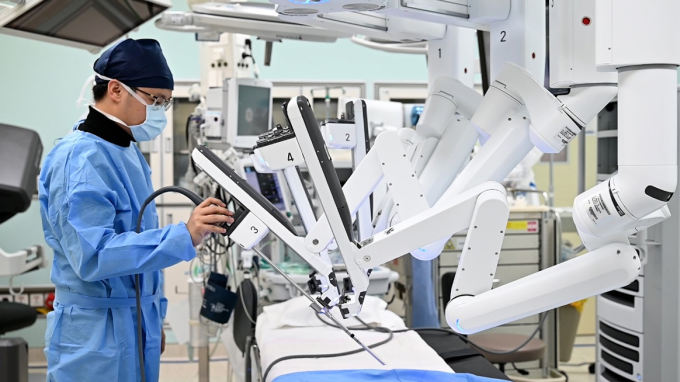
The medical team recommended a robot-assisted laparoscopic partial nephrectomy using the da Vinci surgical system — a minimally invasive procedure designed to remove the tumor while preserving as much healthy kidney tissue as possible.
The important part isn't really the robot.
Robot-assisted systems give surgeons more precise control and enhanced visualization during technically demanding procedures. In practical terms, that can mean smaller incisions, greater precision around delicate tissue, reduced blood loss, and potentially shorter recovery times.
For kidney surgery in particular, preserving healthy tissue matters. Removing the tumor while keeping as much kidney function intact as possible can have long-term benefits for patients.
Inside the Operation
The operation was led by Dr. Dongming Liu at Shanghai United Family Hospital.
Surgeons successfully removed the tumor while preserving kidney function. Post-operative pathology later confirmed a diagnosis of clear cell renal carcinoma, one of the most common forms of kidney cancer.
Because the tumor had been detected early and completely removed, the patient was able to move forward without requiring more extensive intervention.
A Growing Role for Robotic Surgery in Shanghai
Cases like this also reflect a broader shift in healthcare across Shanghai.
Robot-assisted procedures, once associated mostly with highly specialized or headline-grabbing surgeries, are becoming increasingly common in areas such as urology, oncology, and general surgery. The focus isn't the technology itself so much as what it allows doctors to do: operate with precision while minimizing unnecessary impact on surrounding tissue.
Not every patient needs robotic surgery, and not every condition calls for it. But in carefully selected cases, it can create options that simply weren't available a generation ago.

Sometimes Timing Does the Heavy Lifting
For the medical team involved, the case reinforced two familiar lessons: the importance of comprehensive emergency assessment and the value of early detection.
Sometimes a patient arrives with one urgent problem and leaves having discovered another.
Not every surprise diagnosis turns into a positive story.
This one did.

To learn more about Shanghai United Family Hospital's surgical services or make an appointment, scan the code below: